Every year, architects and homeowners choose marble for kitchen countertops based on how it looks in a showroom. Every year, some of them spend money fixing acid etch marks left by lemon juice, vinegar, or wine. The etching isn't a cleaning problem — it's a chemistry problem. And it's completely predictable if you understand what marble actually is.
This comparison isn't about aesthetics — both stones can be beautiful in the right setting. It's about physical properties: hardness, porosity, acid resistance, compressive strength, and maintenance requirements. Once you understand those, the right choice for your specific application becomes obvious.
How They Form — and Why That Matters
Marble is a metamorphic rock — limestone subjected to extreme heat and pressure over millions of years, which recrystallises the calcium carbonate into interlocking crystite grains. That process creates the translucency and veining that makes marble beautiful. It also retains the calcite chemistry that makes it vulnerable to acids.
Granite is igneous — formed from slowly cooled magma deep underground. It's primarily quartz (20–60%), feldspar, and mica, all interlocked in a crystalline matrix. Quartz rates 7 on the Mohs scale — harder than a steel file. Calcite, marble's main constituent, rates 3. That 4-point gap is the practical difference between a stone that scratches and a stone that doesn't.
The Technical Numbers
| Property | Granite | Marble |
|---|---|---|
| Mohs Hardness | 6–7 (quartz component) | 3–4 (calcite base) |
| Compressive Strength | 130–200 MPa | 70–100 MPa |
| Water Absorption | 0.1–0.6% | 0.5–2.0%+ |
| Flexural Strength | ~10.3 MPa minimum | 4.1–33.8 MPa (varies widely) |
| Acid Resistance | High — quartz is inert to most acids | Very low — calcite etches on contact with acids |
| Heat Tolerance | Up to ~650°C | Up to ~540°C |
| Thermal Expansion | ~0.0000044 in/in/°F | Slightly higher; critical for large exterior panels |
The Acid Etching Problem — Explained Once and for All
When an acid contacts marble, it reacts directly with the calcium carbonate: CaCO₃ + 2HCl → CaCl₂ + H₂O + CO₂. The surface calcite dissolves, leaving a dull, rough patch where the polished surface was. This is called etching, and it happens with lemon juice (pH ~2), vinegar (pH ~2.5), wine (pH ~3.3), cola, coffee, and even some all-purpose cleaners.
Sealing delays this — it doesn't prevent it. A sealed marble surface can still etch if acid sits long enough to penetrate. The practical implication: marble in a kitchen will etch unless every acid is wiped up immediately every time. In a hotel lobby with foot traffic only, the acid risk essentially disappears — hence why marble floors last a century in public buildings.
Etching vs staining — different problems
Staining is a discolouration from liquid absorption — fixed with deep cleaning or poultice treatment. Etching is physical surface damage from acid corrosion — it cannot be cleaned away. It requires mechanical re-polishing to fix. Make sure clients understand the difference before specifying marble in wet or food-service environments.
Maintenance Reality — What Each Stone Requires
| Maintenance Factor | Granite | Marble |
|---|---|---|
| Sealing frequency | Once per year (dense types: every 2–3 years) | Every 6 months |
| Daily cleaning | pH-neutral soap or water | pH-neutral only — no vinegar, lemon, bleach ever |
| Scratch risk | Very low — resists all kitchen knives | Medium — scratched by harder minerals, metal edges |
| Stain risk | Low to very low when sealed | Medium to high — wine, oil, coffee absorb quickly |
| Etch risk | None | High in food/drink environments |
| Re-polishing need | Rarely if ever | Every few years in heavy use areas |
Cost Comparison — Where the Price Gap Is Real
| Stone | India Export FOB (USD/sqm) | Approximate Installed (UK, GBP/m²) |
|---|---|---|
| Standard Indian granite | $13–$55 | £300–£800 |
| Premium granite (Black Galaxy, Kashmir White) | $22–$55 | £800–£2,000+ |
| Standard Indian marble (Kumari, Dungri) | $10–$35 | £450–£700 |
| Mid-grade marble (Albeta White) | $47–$94 | £900–£1,500 |
| Premium marble (Makrana Pure White) | $90–$270 | £1,500–£2,500+ |
| Italian marble (Calacatta, Statuario) | $200–$600+ | £2,500–£6,000+ |
The cost comparison is only valid within the same quality tier. Budget granite and budget marble are priced similarly. Where the gap opens is in the premium segment — a truly premium Indian marble (Makrana Pure White or Albeta White) is comparable in price to mid-grade Italian marble, but offers better weathering performance in tropical and monsoon climates.
Where Each Stone Belongs
| Application | Recommended | Why |
|---|---|---|
| Kitchen countertop | Granite | Acid, scratch, heat resistant; low maintenance |
| Bathroom floor / walls | Marble | Low acid exposure; luxury appearance; appropriate humidity tolerance |
| Hotel lobby floor (high traffic) | Granite | Scratch and wear resistance; long-term durability |
| Hotel lobby feature walls | Marble | Aesthetic impact; low wear exposure on vertical surfaces |
| Exterior building cladding | Granite | Acid rain, freeze-thaw, UV resistant; marble can bow and crack on exterior |
| Outdoor paving | Granite or Sandstone | Weather resistance; slip resistance with flamed finish |
| Fireplace surround | Marble | Low acid/wear exposure; heat tolerance adequate; visual warmth |
| Formal reception / dining | Marble | Status and aesthetic; typically low-wear environment |
| Swimming pool coping | Granite (brushed/flamed) | Chemical resistance to pool treatments; slip resistance |
The Indian Varieties Worth Specifying
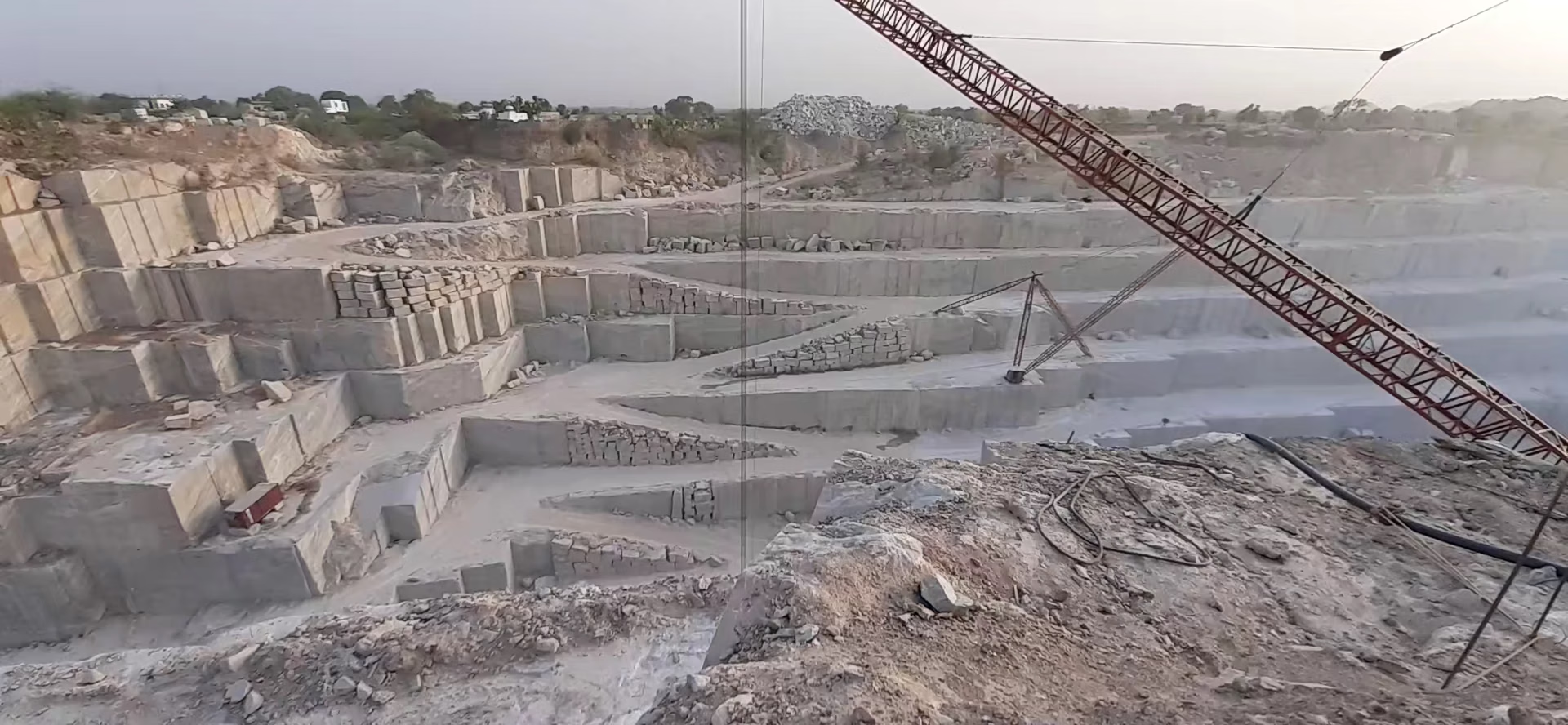
Indian granite is more varied than most international buyers realise. Black Galaxy from Andhra Pradesh — black base with bronze-gold metallic specks — has been in luxury hotels and airports globally since the 1980s. Kashmir White has the dramatic grey and red strip pattern that works in both traditional and contemporary interiors. Absolute Black is exactly what the name suggests: one of the cleanest solid blacks available from any origin, and priced competitively against African alternatives.
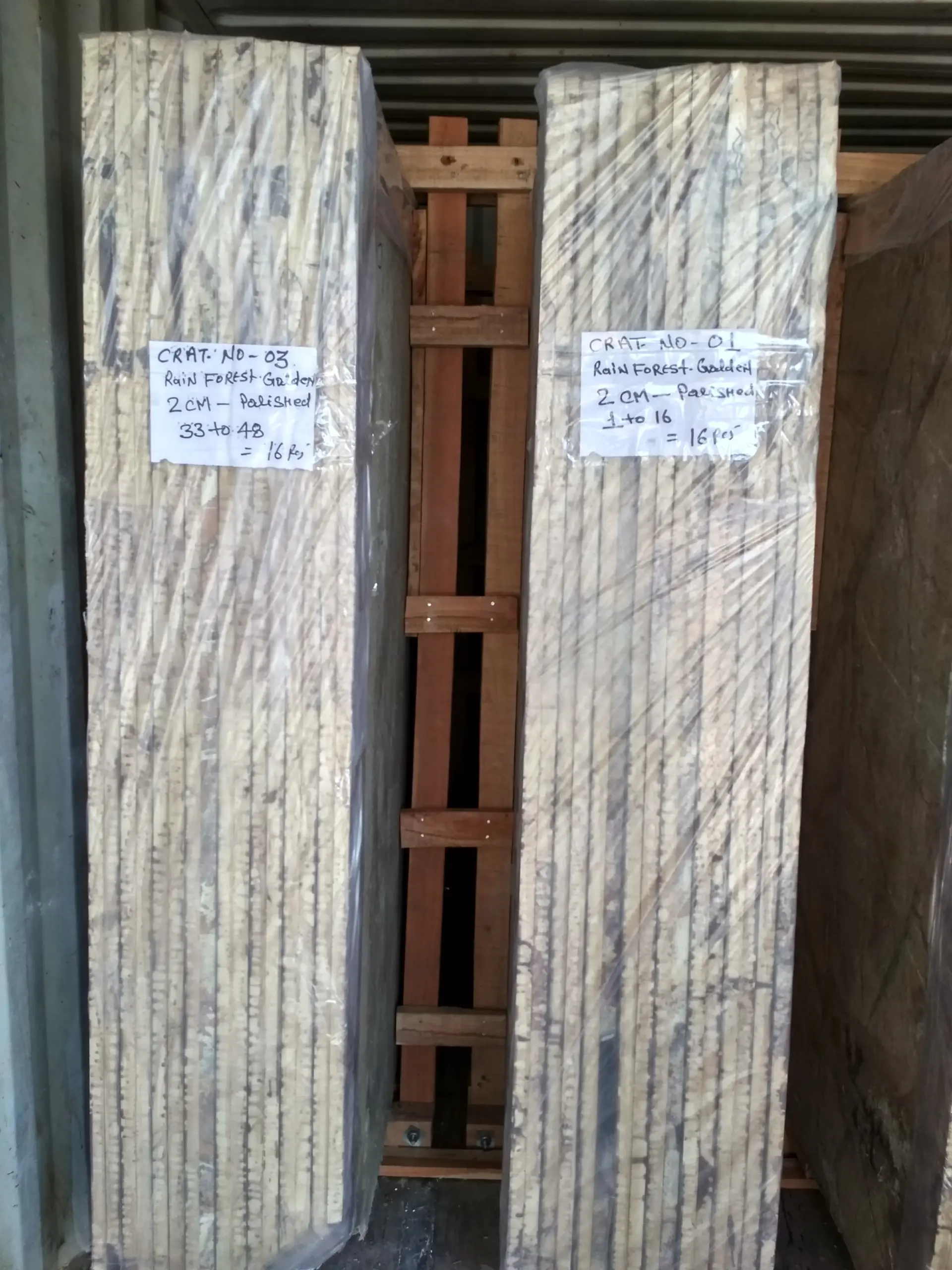
On the marble side, Makrana dominates — but there are other Indian marbles with distinct visual characters. Indian Panda White has bold, high-contrast grey-on-white veining that reads as dramatic as Calacatta but at Indian pricing. Rainforest varieties show complex multi-tone patterns that have no European equivalent.
Request a material specification pack
Opulent Stone Arts can provide technical data sheets — water absorption, compressive strength, density — for any stone in our catalog, alongside physical samples. Contact our export team for a specification pack tailored to your project requirements.