Between 1929 and 1943, 3,000 craftsmen built Umaid Bhawan Palace in Jodhpur without a single drop of mortar. The palace used a specific grade of Jodhpur sandstone called 'Chittar' — or Gur variety — quarried 16 kilometres from the building site, whose interlocking stone properties meant it could be assembled dry and still stand. It's now a Taj Hotels property, and if you walk through it today, the sandstone hasn't moved.
Rajasthan produces approximately 90% of India's total sandstone output. The UK alone imports 62% of all Indian sandstone exports — more than $57 million worth in 2020–21. For garden paving, heritage restoration, and architectural facades, Jodhpur sandstone has become the benchmark material in British landscape architecture. This guide covers what that market knows that others often don't.
The Geology — Why the Colour Varies
Jodhpur sandstone is a quartz arenite — primarily quartz grains (SiO₂ = 96.60%) bound by ferruginous (iron oxide) cement. The colour of any given block is determined almost entirely by how much iron oxide is present in the cementing material and which form of iron oxide it is:
| Colour | Iron Oxide Content | Key Applications |
|---|---|---|
| Pink | Moderate Fe₂O₃ | Most exported variety globally; signature Jodhpur colour; facades, paving, garden walling |
| Red / Reddish-brown | High Fe₂O₃ | Red Fort, Delhi; Parliament House; heritage-grade cladding |
| Buff / Honey (Chittar) | Low iron; Gur variety — dense, non-splittable | Umaid Bhawan Palace; premium dry-stone construction; countertops |
| Brown / Dark brown | High iron, different mineralogy | Mehrangarh Fort; traditional Jodhpur vernacular architecture |
| White / Cream | Very low iron oxide | Specialty use; contrast elements in mixed stone facades |
| Grey / Greenish | Mineral inclusions | Available from specific quarry horizons; less common in export |
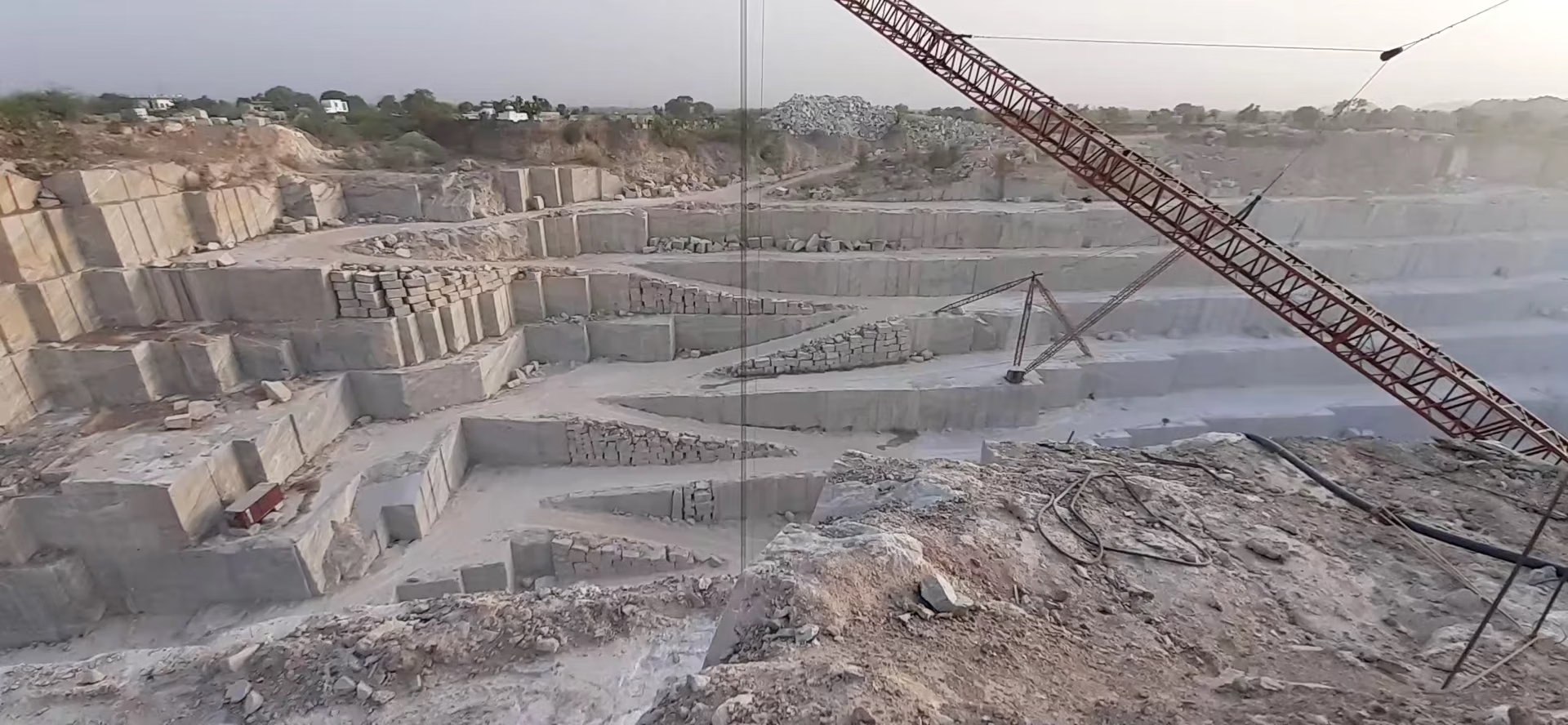
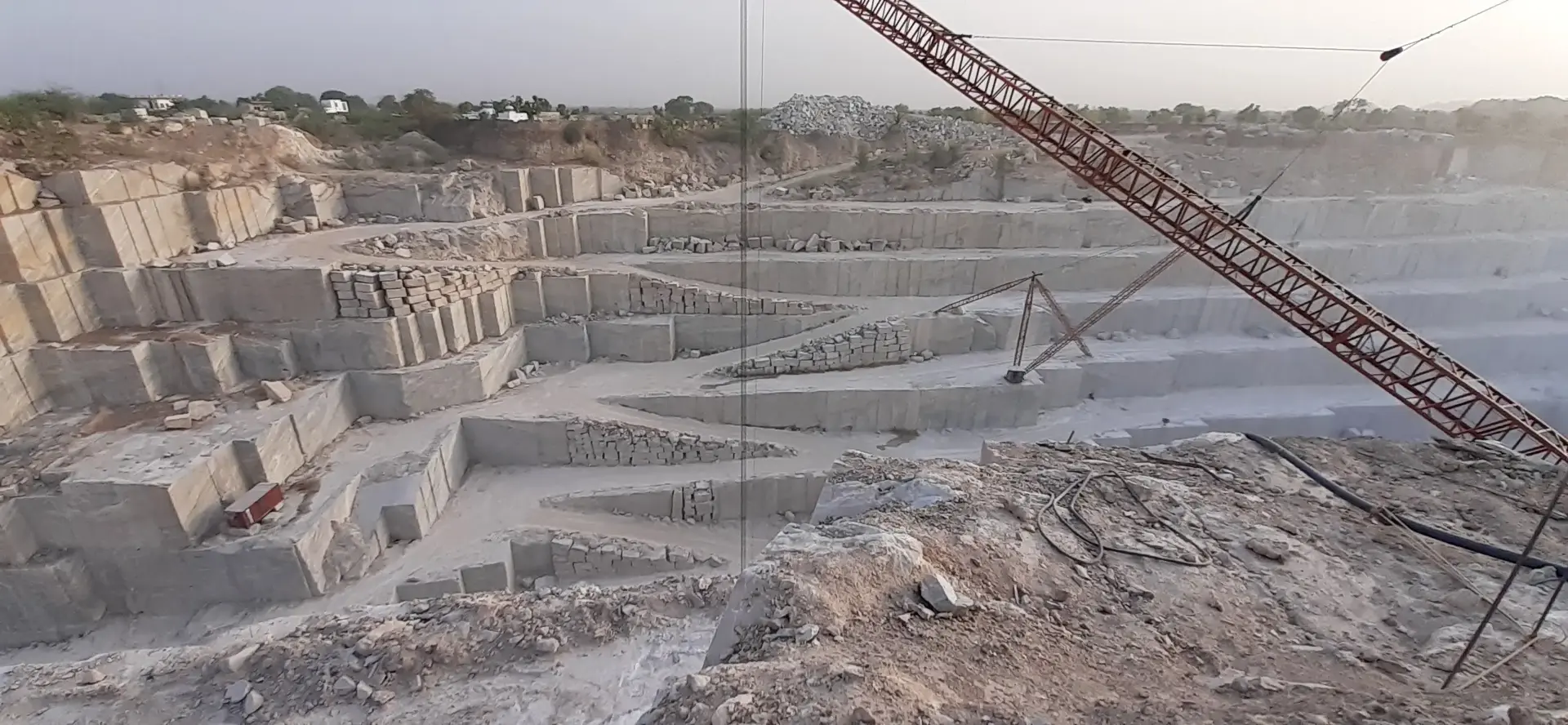
Sandstone from the middle quarry horizon — not too close to the surface, not too deep — is consistently the highest quality: densest, most uniform, least porous. Ask your supplier which horizon the stone is drawn from. Surface-quarried stone is more variable and often softer.
Technical Specifications
| Property | Value |
|---|---|
| Compressive Strength | 390 kg/cm² |
| Modulus of Rupture | 220 kg/cm² |
| Water Absorption | 1.25% |
| Density | 2,420 kg/m³ |
| Main Composition | SiO₂ = 96.60% | Fe₂O₃ = 1.20% | Al₂O₃ = 1.00% |
| Age (geological) | Ediacaran–Cambrian, ~541–600 million years |
| Chemical Resistance | Good resistance to acid, alkali, salinity, and thermal variation |
One technical note that matters in practice: unlike granite or marble, individual sandstone blocks can vary significantly in porosity and compressive strength depending on which quarry horizon they come from. Two slabs from the same quarry, quarried one metre apart vertically, can perform differently. This is why reputable exporters specify the horizon and can provide batch-level test data on request.
The Architecture: Buildings That Define the Stone
Understanding where a stone has been used — and how it has performed — is the fastest way to understand what it can do for a new project:
- —Mehrangarh Fort, Jodhpur (1459 AD) — All buildings in brown-to-red sandstone; intricate carved jali lattice screens; still structurally intact after 565 years in desert climate
- —Umaid Bhawan Palace, Jodhpur (1929–1943) — Chittar (Gur) variety; mortar-free interlocking construction; 14-year build; now a Taj Hotels property
- —Red Fort (Lal Qila), Delhi (1639–1648) — Named for its red sandstone walls; Mughal-era Rajasthan sandstone procurement
- —Rashtrapati Bhavan, New Delhi (1929) — Dholpur and sandstone varieties; Lutyens and Herbert Baker; Indo-Saracenic architecture
- —Parliament of India, New Delhi — Sandstone construction; ongoing heritage status
- —Humayun's Tomb, Delhi (1570) — Red sandstone with white marble inlay; UNESCO World Heritage Site; prototype for later Mughal architecture
- —Osian Temple Complex, Rajasthan (8th century AD) — Known as "the Khajuraho of Rajasthan"; intricate sandstone carving has survived 1,200 years
16 Surface Finishes — and When to Use Each
Jodhpur sandstone takes more surface finishes than almost any other stone — the iron oxide chemistry responds differently to each process, creating genuinely distinct visual results:
| Finish | Texture / Appearance | Best Application |
|---|---|---|
| Polished | Smooth, reflective, colour intensified | Interior flooring, feature walls, reception counters |
| Honed | Smooth, matte, consistent colour | Interior floors, wall cladding, countertops |
| Sandblasted / Shot Blast | Uniform texture, light colour, slightly rough | Exterior paving, anti-slip surfaces |
| Flamed | Rough, textured, colour lightened | Exterior paving, pool coping, steps |
| Natural Split / Cleft | Irregular planes, rustic, full colour variation | Garden walling, rockery, retaining walls |
| Chiselled | Hand-worked edges, antique character | Heritage projects, traditional architecture |
| Linear Chiselled | Parallel tooling lines, directional texture | Facade cladding, architectural feature walls |
| Lichi (Lychee) | Dimpled, organic, slip-resistant | Outdoor floors, courtyard paving, pool surrounds |
| Pineapple | Dense patterned texture | Decorative wall panels, landscape features |
| Point Stalk | Mechanically pointed rough surface | Heavy-duty exterior, commercial paving |
| Bush-hammered | Uniform pitted texture, non-slip | Commercial exterior floors, public space paving |
| Brushed / Antique | Soft, aged appearance, slightly textured | Heritage restoration, period-appropriate interiors |
Export Pricing — Current Rates
| Variety | Export Price (USD/sqm FOB) |
|---|---|
| Jodhpur Pink (standard export grade) | $25 – $28 |
| Jodhpur Red | $25 – $30 |
| Buff / Chittar (Gur variety) | $30 – $42 |
| Jaisalmer Yellow | $12 – $23 |
| Kandla Grey | $10 – $20 |
| Dholpur Beige | $10 – $19 |
| Mint / Fossil sandstone | $12 – $24 |
Domestic prices in India range from ₹52 to ₹700 per sqft depending on variety, finish, and thickness. The gap between domestic and export FOB pricing reflects export processing costs — the stone needs to be dimensioned, finished, and packed to international specifications.
Why the UK Is the World's Largest Sandstone Importer
The UK consumes 62% of all Indian sandstone exports — approximately $57 million in 2020–21. The reason is primarily landscape architecture: British garden and patio culture demands large-format natural stone paving, and Jodhpur sandstone competes on colour, consistency, and price against York stone (which is quarried domestically but in limited quantities and at much higher price points).
Indian Pink sandstone in calibrated 600×300mm and 600×600mm formats has become the default mid-market garden paving in the UK, stocked by nearly every major landscape supplier. The premium end of the UK market uses Mint, Fossil, and Buff Chittar varieties for projects where colour variation is specified.
Specify Jodhpur sandstone for your project
Opulent Stone Arts exports all major Jodhpur and Rajasthan sandstone varieties — Pink, Red, Buff Chittar, Jaisalmer Yellow — in calibrated tiles, split-face panels, and dimensional blocks. We supply landscape architects, importers, and distributors across Europe, the Middle East, and Australia. Contact us for a current price list and sample set.